
Peptides

Best Peptides for Testosterone in 2026: An Honest Guide

Best Peptides for Testosterone in 2026: An Honest Guide

Last Updated

Jun 10, 2026

Table of contents

My interest in hormonal optimization did not start with a crisis. It started with a slow decline in energy, focus, and drive. I suspected testosterone was part of the picture, and while TRT is the obvious path, my research kept pulling me toward something more targeted: peptides that work with the body’s own production system instead of overriding it.

This is the result of that investigation, written for the data-minded reader who wants mechanism and clinical context, not hype. There is no single best peptide for testosterone. There is a spectrum of signaling molecules, each acting at a different level of the hypothalamic-pituitary-gonadal (HPG) axis, the command center for hormone production. Understand where each one acts, and the right choice for your situation becomes obvious. That is what the map below is for.

The map

Where each peptide acts on the axis.

Testosterone production runs top-down through the HPG axis. Each peptide plugs in at a different level, and that single fact explains its use case, its power, and its risks.

Level 1 · Brain
Hypothalamus

Fires GnRH in rhythmic pulses every 90 to 120 minutes. This is the genesis of the whole cascade.

Kisspeptin · switches the GnRH neurons on
Level 2 · Signal
GnRH release

The pulse tells the pituitary to act. Replicate the rhythm and you reboot the system. Flood it continuously and you shut it down.

Gonadorelin · replicates the pulseLHRH agonists · flare, then suppress
Level 3 · Gland
Pituitary gland

Responds to the GnRH pulse by secreting Luteinizing Hormone (LH) and Follicle-Stimulating Hormone (FSH).

Level 4 · Messenger
LH and FSH

Travel through the blood to the testes. LH is the direct on-switch for testosterone synthesis.

HCG · mimics LH at the testes
Level 5 · Factory
Testes · Leydig cells

Receive the LH signal and produce testosterone, while also maintaining sperm production and testicular volume.

Output
Testosterone + fertility

The end product the entire axis exists to make.

Parallel pathway · not the HPG axis
Brain melanocortin receptors

PT-141 works outside the axis entirely. It acts on arousal pathways in the brain, supporting the libido and sexual function that keep the system reinforced, rather than producing testosterone directly.

PT-141 · central arousal, supportive role
Available by prescription Investigational Specialist or supportive use

Side by side

The five, compared.

PeptideActs onMechanismBest forStatus
Gonadorelin
GnRH analogue
Hypothalamus to pituitary signal Pulsed dosing reboots the entire axis from the top down Secondary hypogonadism, restoring natural production and fertility Prescription
HCG
LH mimetic
Testes (Leydig cells) Mimics LH, directly stimulating testosterone production Preventing testicular atrophy and preserving fertility on TRT Prescription
Kisspeptin
Kiss1
Above GnRH (the GnRH neurons) Master switch that triggers GnRH release; deepest upstream point Diagnosis and investigational treatment of central hypogonadism Investigational
LHRH agonists
Leuprolide, triptorelin
Pituitary GnRH receptors Brief testosterone flare, then desensitizes and shuts the axis down Specialist procedural use only, not ongoing optimization Specialist
PT-141
Bremelanotide
Brain melanocortin receptors Central arousal pathway, supports libido rather than testosterone directly Low libido or sexual dysfunction, often alongside TRT Prescription

Match to goal

Which one for which goal.

The honest answer to "what is the best peptide for testosterone" depends entirely on what you are solving for.

Restart your own production
Pick: Gonadorelin, which restores the full axis rather than replacing the end hormone.
Stay fertile while on TRT
Pick: HCG, to keep the testes active and prevent shutdown and atrophy.
Address libido or sexual function
Pick: PT-141, which targets desire at the brain, on demand.
Diagnose a complex case
Pick: Kisspeptin, an investigational tool that tests the axis from the very top.
General testosterone optimization
Not LHRH agonists. Their brief flare is followed by suppression, the opposite of what you want.
Decide between any of them
Start with data: baseline labs and a clinician, not a vial.

In depth

The five peptides, explained.

01

GnRH (Gonadorelin)

Acts at: hypothalamus to pituitary, top of the axis

GnRH is the master regulator and the very first domino. Produced in the hypothalamus, it signals the pituitary to release LH and FSH, which in turn drive the testes to make testosterone. The critical detail is its pulsatile nature: the body releases it in bursts every 90 to 120 minutes, and a continuous stream paradoxically shuts production down. Therapeutic use with a synthetic analogue like gonadorelin therefore aims to replicate that rhythm, often through a micro-infusion pump, restoring the entire axis from the top rather than replacing the final hormone the way TRT does.

Ideal candidate

  • Men with secondary hypogonadism, specifically isolated hypogonadotropic hypogonadism (healthy testes, missing brain signal)
  • Anyone prioritizing fertility and testicular function alongside testosterone

How it compares

  • Unlike TRT, it kickstarts production instead of suppressing it
  • Works further upstream than HCG, restoring the whole axis rather than just the testes
Monitoring: Manage this with an endocrinologist experienced in pulsatile administration. Expect frequent LH, FSH, and testosterone testing, pump-based dosing every 90 to 120 minutes, and several months before levels fully normalize.
02

HCG (Human Chorionic Gonadotropin)

Acts at: the testes, mimicking LH

HCG goes straight to the factory floor. It mimics LH, binding the receptors on the Leydig cells in the testes and commanding them to produce testosterone and hold their volume. By bypassing the brain and pituitary entirely, it delivers a reliable, predictable boost in the body’s own production, which is exactly why it is a staple for preventing the testicular shutdown that standalone TRT tends to cause.

Ideal candidate

  • Men on TRT who want to prevent testicular atrophy and preserve fertility
  • Fertility-clinic patients restarting production before assisted reproduction

How it compares

  • More direct than GnRH, but does not restore the brain-level signaling
  • Effects appear fast, often within 2 to 4 weeks
Monitoring: Typical dosing is 500 to 1000 IU, two to three times weekly by subcutaneous injection, under a clinician who tracks estradiol, since stimulating testosterone also raises its conversion to estrogen.
03

Kisspeptin (Kiss1)

Acts at: above GnRH, the deepest upstream point

Kisspeptin sits one level above GnRH, acting as the conductor that cues the first domino. Produced in the hypothalamus, it directly activates the GnRH-producing neurons, triggering the cascade that ends in testosterone. Administering it produces a robust, immediate rise in GnRH, LH, FSH, and testosterone, which also makes it a uniquely powerful diagnostic for confirming whether the entire axis is functional from the brain down.

Ideal candidate

  • Complex or central hypogonadism, in research and advanced diagnostic settings
  • Investigational use for low libido, where it has shown effects independent of testosterone

How it compares

  • Even more upstream than GnRH, addressing the neural control of the system
  • Still largely investigational; long-term safety and efficacy are not yet established
Monitoring: Confined to research trials and specialized endocrinology centers, administered by IV or subcutaneous injection under observation. Treat it as investigational, not a routine therapy, and do not seek it from unregulated sources.
04

LHRH Agonists (Leuprolide, Triptorelin, Goserelin)

Acts at: pituitary GnRH receptors

These synthetic peptides offer only a brief, paradoxical window for raising testosterone. Structurally similar to GnRH, they first overstimulate the pituitary receptors, producing a 7 to 14 day surge in LH, FSH, and testosterone. Then the continuous signal desensitizes those receptors, shuts the axis down, and drops testosterone to castrate levels. Their primary clinical use is actually to suppress testosterone, so harnessing the initial flare is a narrow, specialized application.

Ideal candidate

  • Specific reproductive-medicine procedures, such as triggering oocyte maturation in IVF
  • Testing pituitary reserve under a specialist protocol

How it compares

  • Opposite of pulsatile GnRH: one spike, then shutdown
  • Unsuitable for ongoing testosterone optimization by design
Monitoring: Only ever under a reproductive endocrinologist or urologist. Any testosterone rise is temporary and intentionally followed by suppression, so a clear plan must be in place to manage the aftermath.
05

PT-141 (Bremelanotide)

Acts at: brain melanocortin receptors, outside the axis

PT-141 takes an indirect route. Rather than stimulating hormone production, it binds melanocortin receptors in the hypothalamus to enhance arousal and sexual function, initiating desire from the brain rather than through the vascular pathway that drugs like Viagra use. Its link to testosterone is the well-documented loop between libido, sexual activity, and hormonal health: by restoring that fundamental part of male function, it helps create an environment where natural production thrives.

Ideal candidate

  • Men with low libido or psychological ED, even when testosterone is in range
  • An adjunct to TRT when raised testosterone has not translated to desire

How it compares

  • Works on demand and from the brain, effective when ED medications fail
  • Supportive rather than a direct testosterone driver
Monitoring: Self-administered subcutaneously about 30 to 45 minutes before activity. Start with a low test dose to gauge nausea and flushing, monitor blood pressure given a temporary rise, and use as-needed only to avoid receptor desensitization.

The path forward

From information to action.

Mechanism matters most

How a peptide works decides whether it fits you and how it must be monitored. A direct LH mimic like HCG and an upstream activator like kisspeptin are not interchangeable.

Data is your compass

You cannot manage what you do not measure. A full baseline panel is non-negotiable, and ongoing testing is the feedback loop that lets you adjust safely.

Total TFree TSHBGLHFSHEstradiol

Expert supervision is mandatory

This is not a do-it-yourself endeavor. The potential to disrupt your entire endocrine system is real. A qualified clinician interprets your labs, designs a safe protocol, and manages side effects.

The question quietly upgrades itself. Not "what is the best peptide for testosterone," but "what is the best data-informed, medically supervised strategy for my specific biology." That shift, from chasing a magic bullet to building a system, is the whole game.

The data-driven version

OneTwenty builds the system, not the guesswork.

Navigating this well takes a partner built around data. OneTwenty pairs comprehensive lab testing (Total T, Free T, SHBG, LH, FSH, Estradiol, and more) with continuous wearable data and clinician-supervised protocols spanning TRT and the prescribable peptides covered here, including gonadorelin and PT-141. OneTwenty launches in June 2026 with medications.

Join the beta

Quarterly panels · wearable integration · clinician-supervised · $499/yr

This article is educational and is not medical advice. Peptide and hormone therapies can disrupt the endocrine system and must be started and monitored by a licensed clinician using baseline and ongoing bloodwork. Availability and legal status of specific compounds vary and change over time.
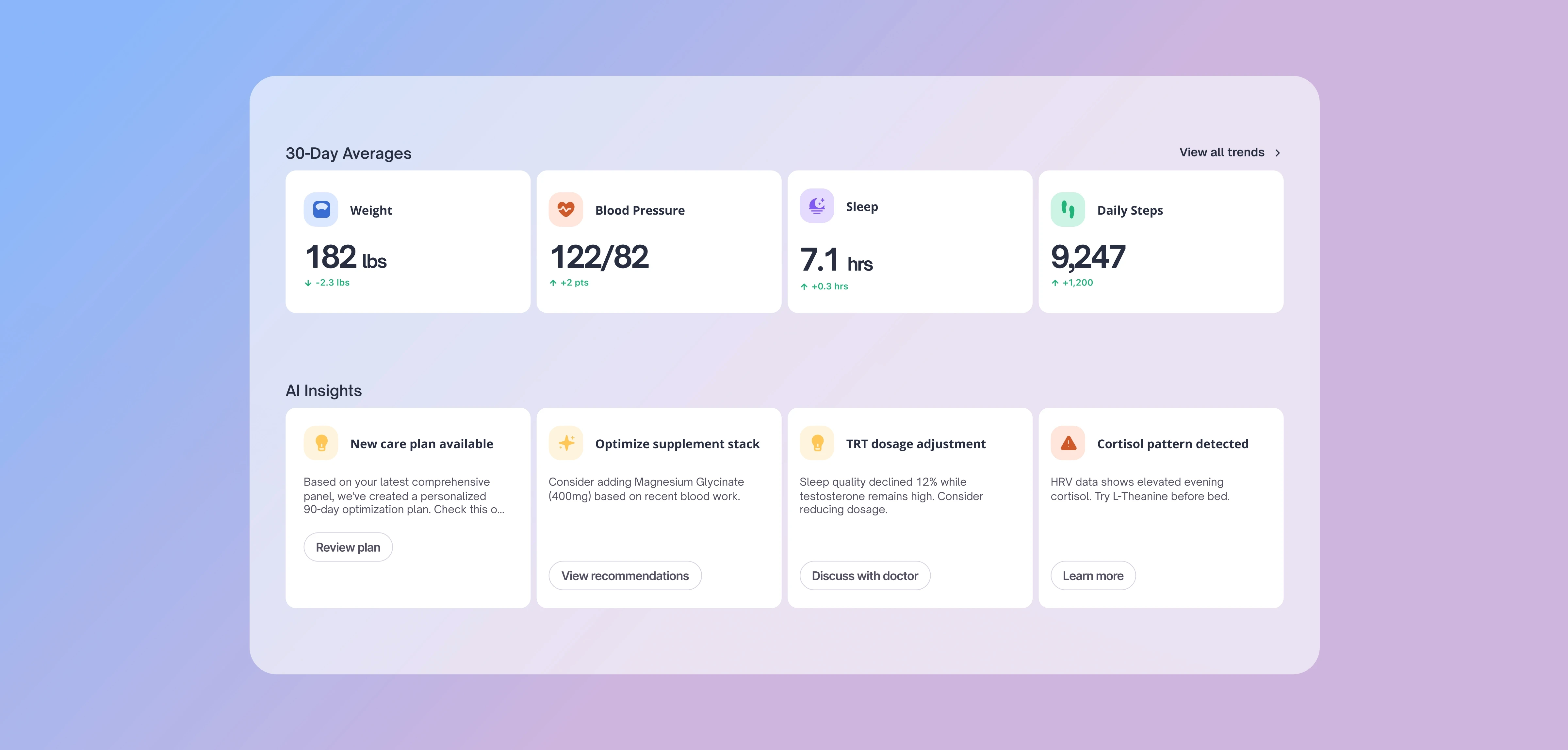
How OneTwenty Works

How OneTwenty Works

Sign Up - Schedule Initial Labs

Get started with comprehensive lab work, done from any Quest location or at-home phlebotomy appointment add on.

Buy or Connect Your Wearable of Choice

Connect your own wearable device for seamless health monitoring.

Buy Your Scale and Blood Pressure Monitor

Complete body and cardiovascular composition analysis and tracking.

Get Your Action Plan

Receive personalized recommendations based on your health data.

Track in Real Time

+ Get Adjusted

Continuous monitoring with real-time adjustments to your health plan.

Sign Up - Schedule Initial Labs

Get started with comprehensive lab work, done from any Quest location or at-home phlebotomy appointment add on.

Buy or Connect Your Wearable of Choice

Connect your own wearable device for seamless health monitoring.

Buy Your Scale and Blood Pressure Monitor

Complete body and cardiovascular composition analysis and tracking.

Get Your Action Plan

Receive personalized recommendations based on your health data.

Track in Real Time

+ Get Adjusted

Continuous monitoring with real-time adjustments to your health plan.

Sign Up - Schedule Initial Labs

Get started with comprehensive lab work, done from any Quest location or at-home phlebotomy appointment add on.

Buy or Connect Your Wearable of Choice

Connect your own wearable device for seamless health monitoring.

Buy Your Scale and Blood Pressure Monitor

Complete body and cardiovascular composition analysis and tracking.

Get Your Action Plan

Receive personalized recommendations based on your health data.

Track in Real Time

+ Get Adjusted

Continuous monitoring with real-time adjustments to your health plan.

Lifelong Optimization

Not your average
Checkup

Every life stage brings new biological demands. Tracking the right metrics at the right time helps you adapt, optimize performance, and extend both lifespan and healthspan.

Traditional

Manual Data Processing

Guesswork Trend Detection

Slow Campaign Setup

Multiple Tools, Multiple Logins

Reactive Decision-Making

Manual Reporting

Delayed Results

High Error Risk

Automated Data Sync

Real-Time Trend Insights

Instant AI Optimization

All-in-One Platform

Proactive AI-Driven Strategies

Auto-Generated Reports

Instant Performance Updates

AI Precision

Lifelong Optimization

Join The

Closed Beta

We are currently in closed beta with limited capacity.

Open Beta · Launching June

HSA/FSA Approved

50% off for Founding Members

Hey Nick,

Your Quarterly Review

ApoB Density +12% → Elevated cardiovascular risk

Resting HR +6 bpm → Possible overtraining or stress

Sleep Time -42 min → Reduced nightly recovery

BMI Shift -1.8% → Healthy weight improvement

HRV Recovery +22ms → Stronger stress resilience

→ Suggesting root cause (AI Coming soon)

Lifelong Optimization

Join The

Closed Beta

We are currently in closed beta with limited capacity.

First Closed Beta Full
·
Accepting Reservations for Second Cohort

HSA/FSA Approved

50% off for Founding Members

Hey Nick,

Your Quarterly Review

ApoB Density +12% → Elevated cardiovascular risk

Resting HR +6 bpm → Possible overtraining or stress

Sleep Time -42 min → Reduced nightly recovery

BMI Shift -1.8% → Healthy weight improvement

HRV Recovery +22ms → Stronger stress resilience

→ Suggesting root cause (AI Coming soon)

Frequently Asked Questions

Clarity before

you commit

Answers on setup, scale, and support to remove blockers.

What’s included in the membership?

Do you accept HSA and FSA?

Do I have to take medications?

Is OneTwenty available in my state/country?

Is my health data secure? (HIPAA Standards)

Do you treat medical conditions?

Why can't I use my insurance for these labs?

Y

ur

Data

Your

D

e

ices

Your

Longevity

OneTwenty

Live guidance for sleep, hormones, and weight powered by your wearables, smart devices and blood work

Important Details:

*Up to 165 lab data points per year. Exact number varies based on your baseline results and which biomarkers your physician retests each quarter.

**Due to state-specific lab draw requirements in New York and New Jersey, testing is conducted twice per year instead of quarterly. Pricing reflects the higher cost of at-home phlebotomy in these states.


Disclaimer:

OneTwenty is a health technology company. We are not a medical provider, laboratory, or pharmacy. We provide data and tools to help you make informed decisions about your own health and better understand your biological needs.

All clinical services, including lab testing, telehealth consultations, and prescription fulfillment, are provided exclusively by independent, licensed third parties.


OneTwenty facilitates secure communication between you and these providers. OneTwenty does not prescribe medications, provide diagnoses, or offer medical treatment. While we provide personalized insights and protocols, these are not a substitute for professional medical advice.

Always consult your primary care physician before making changes to your health regimen. OneTwenty does not replace your relationship with your physician.

Y

ur

Data

Your

D

e

ices

Your

Longevity

OneTwenty

Live guidance for sleep, hormones, and weight powered by your wearables, smart devices and blood work

Important Details:

*Up to 165 lab data points per year. Exact number varies based on your baseline results and which biomarkers your physician retests each quarter.

**Due to state-specific lab draw requirements in New York and New Jersey, testing is conducted twice per year instead of quarterly. Pricing reflects the higher cost of at-home phlebotomy in these states.


Disclaimer:

OneTwenty is a health technology company. We are not a medical provider, laboratory, or pharmacy. We provide data and tools to help you make informed decisions about your own health and better understand your biological needs.

All clinical services, including lab testing, telehealth consultations, and prescription fulfillment, are provided exclusively by independent, licensed third parties.


OneTwenty facilitates secure communication between you and these providers. OneTwenty does not prescribe medications, provide diagnoses, or offer medical treatment. While we provide personalized insights and protocols, these are not a substitute for professional medical advice.

Always consult your primary care physician before making changes to your health regimen. OneTwenty does not replace your relationship with your physician.

Y

ur

Data

Your

D

e

ices

Your

Longevity

OUTLIVE.

Live guidance for sleep, hormones, and weight powered by your wearables, smart devices and blood work

Important Details:

*Up to 165 lab data points per year. Exact number varies based on your baseline results and which biomarkers your physician retests each quarter.

**Due to state-specific lab draw requirements in New York and New Jersey, testing is conducted twice per year instead of quarterly. Pricing reflects the higher cost of at-home phlebotomy in these states.


Disclaimer:

OneTwenty is a health technology company. We are not a medical provider, laboratory, or pharmacy. We provide data and tools to help you make informed decisions about your own health and better understand your biological needs.

All clinical services, including lab testing, telehealth consultations, and prescription fulfillment, are provided exclusively by independent, licensed third parties.


OneTwenty facilitates secure communication between you and these providers. OneTwenty does not prescribe medications, provide diagnoses, or offer medical treatment. While we provide personalized insights and protocols, these are not a substitute for professional medical advice.

Always consult your primary care physician before making changes to your health regimen. OneTwenty does not replace your relationship with your physician.

Stop Guessing Your Health

Live guidance for sleep, hormones, and weight powered by your wearables, devices + blood work.

Join Beta

Join Beta Waitlist

Stop Guessing Your Health

Live guidance for sleep, hormones, and weight powered by your wearables, devices + blood work.

Join Beta

Join Beta Waitlist